
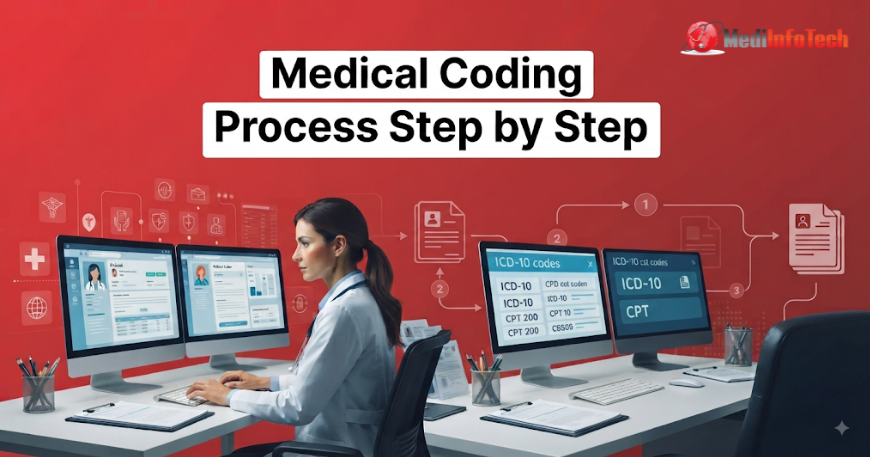
Medical coding is an essential part of modern healthcare administration. Every patient visit generates important clinical information, including diagnoses, treatments, procedures, tests, and services provided by healthcare professionals. CPC Certification Course in Hyderabad. Medical coders convert this information into standardized medical codes that support billing, insurance claims, reporting, compliance, and healthcare data management.
Understanding the medical coding process step by step helps healthcare organizations, medical professionals, students, and aspiring coding specialists recognize how clinical documentation becomes accurate and standardized coding information.
What is the Medical Coding Process?
The medical coding process involves reviewing a patient’s medical documentation and translating relevant diagnoses, procedures, services, and conditions into standardized codes.
Professional medical coders work with clinical documents such as physician notes, discharge summaries, operative reports, laboratory reports, diagnostic reports, and treatment records. They identify the information required for coding and assign the appropriate codes according to established coding guidelines.
Common coding systems include:
- ICD: Used primarily to report diagnoses and health conditions.
- CPT: Used to report many medical procedures and professional services.
- HCPCS: Used for specific healthcare services, supplies, products, and procedures.
- Modifiers: Used when additional information is needed to describe a service or procedure accurately.
The objective is not simply to assign a code. Coders must understand documentation, apply coding guidelines correctly, verify information, and maintain consistency throughout the process.
Medical Coding Process Step by Step
Step 1: Collect and Review Patient Documentation
The first stage begins with gathering the patient’s relevant medical records. Depending on the healthcare setting, documentation may include physician notes, consultation reports, operative notes, laboratory results, imaging reports, medication information, and discharge summaries.
The medical coder carefully reviews the documentation to understand why the patient received care and what services were performed. Our certificate is recognized as a mark of job readiness.
At this stage, accuracy is extremely important. A coder should not make assumptions about a diagnosis or procedure that is not supported by the available documentation.
Step 2: Identify the Main Diagnosis and Medical Conditions
After reviewing the medical records, the coder identifies the documented diagnoses, symptoms, conditions, or reasons for the patient’s encounter.
The coder determines which diagnosis is relevant to the encounter and identifies any additional conditions that may need to be reported.
For example, a patient may visit a healthcare provider for a specific condition while also having other documented medical conditions that affect the treatment or management of the patient.
Correctly identifying the documented conditions helps ensure that the coding reflects the actual care provided.
Step 3: Identify Procedures and Services Provided
The next step is to determine which procedures, examinations, treatments, or professional services were performed during the patient’s encounter.
The coder reviews the documentation to identify services such as consultations, diagnostic tests, surgical procedures, therapeutic services, or other documented healthcare activities.
The procedure must be supported by the medical record. Coding should accurately represent the service documented by the healthcare provider rather than relying on assumptions.
Step 4: Select the Appropriate Medical Codes
Once the diagnoses, procedures, and services have been identified, the coder searches the appropriate coding references to determine the correct codes.
For diagnosis coding, the coder may use the applicable ICD code set. Procedures and professional services may require CPT codes, while certain supplies and healthcare services may use HCPCS codes.
This stage requires knowledge of coding guidelines, terminology, anatomy, medical documentation, and code-specific requirements.
The coder must select the most appropriate code supported by the documentation and follow applicable coding conventions.
Importance of Accurate Medical Coding
Accurate medical coding is important for more than billing. It contributes to the overall efficiency and reliability of healthcare administration.
Some major benefits include:
Improved Claim Accuracy
Correct coding can help ensure that claims accurately represent the services and diagnoses documented in the patient’s record.
Reduced Coding Errors
A structured review process can identify potential mistakes before coded information moves further through the billing workflow.
Better Healthcare Data
Standardized codes help organizations organize clinical information for reporting, analysis, research, and healthcare management.
Compliance Support
Following applicable coding guidelines and maintaining documentation-based coding practices can help organizations establish more consistent and compliant processes.
Efficient Revenue Cycle Management
Accurate coding can contribute to smoother billing workflows and help reduce avoidable delays associated with coding-related claim issues.
Organizations looking for professional support can explore medical coding services to understand how specialized coding assistance can complement their healthcare operations.
Skills Required for Medical Coding
Medical coding requires a combination of healthcare knowledge, analytical ability, attention to detail, and familiarity with coding systems.
Important skills include:
- Knowledge of medical terminology
- Understanding of anatomy and physiology
- Knowledge of ICD, CPT, and HCPCS coding systems
- Strong attention to detail
- Ability to interpret clinical documentation
- Understanding of coding guidelines
- Analytical and research skills
- Computer and healthcare software proficiency
- Commitment to accuracy and confidentiality
For individuals interested in developing these skills, professional medical coding training can provide structured learning and practical exposure to coding concepts.
Common Challenges in the Medical Coding Process
Medical coding professionals may encounter several challenges during their daily work. Complex medical terminology, incomplete documentation, frequent guideline updates, specialty-specific requirements, and differences in payer policies can make coding demanding.
Some records may also contain multiple diagnoses and procedures, requiring careful review to determine the correct codes and sequencing.
Continuous learning is therefore important for coding professionals. Staying updated with coding guidelines, industry developments, and documentation requirements can support long-term accuracy.
Healthcare organizations can also benefit from establishing clear workflows, regular quality audits, coder education, and documentation improvement practices.
Build an Accurate Medical Coding Workflow
The medical coding process step by step starts with reviewing patient documentation and identifying diagnoses and services. It continues through code selection, specificity checks, guideline verification, documentation review, quality assurance, and finalization.
Every stage plays an important role in producing reliable medical coding information. Accurate coding can support claim processing, healthcare reporting, compliance, revenue cycle management, and better administrative efficiency.
Whether you are a healthcare organization seeking coding support or an individual interested in understanding the field, a clear knowledge of the medical coding workflow provides a strong foundation.
Conclusion
Looking for reliable medical coding support for your healthcare organization?
Contact Medi Info Tech today to discuss your medical coding requirements and discover how professional coding services can support accuracy, efficiency, and streamlined healthcare administration
