
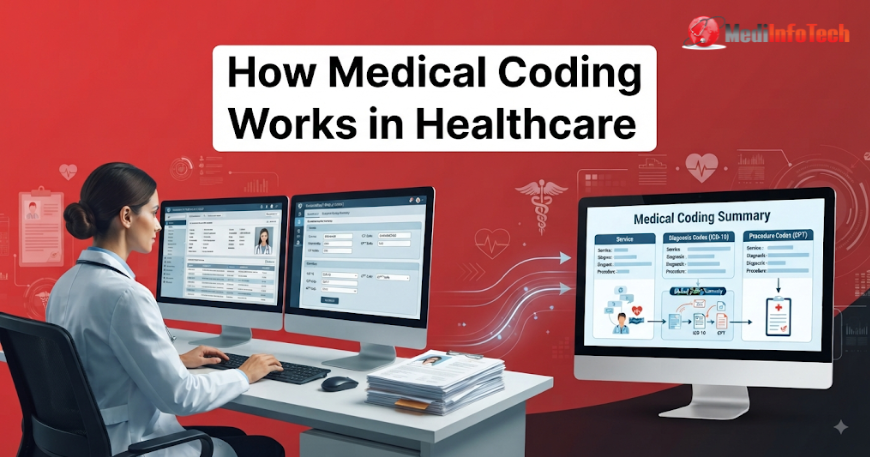
Medical coding is a fundamental part of the healthcare revenue cycle and administrative process. Every time a patient visits a doctor, hospital, clinic, diagnostic center, or other healthcare provider, the encounter generates clinical documentation. Medical coders transform relevant information from these records into standardized medical codes for billing, insurance claims, reporting, compliance, and healthcare data management.
At Medi Info Tech, professional medical coding services help healthcare organizations maintain structured coding workflows and support accurate healthcare administration. Understanding how medical coding works can help providers, healthcare businesses, students, and aspiring coding professionals appreciate the role coding plays throughout the healthcare system.
What is Medical Coding in Healthcare?
Medical coding is the process of converting healthcare information into standardized alphanumeric codes. These codes represent diagnoses, diseases, symptoms, procedures, treatments, medical services, and certain supplies documented during a patient’s healthcare encounter.
Healthcare providers generate extensive clinical information, but standardized codes make that information easier to process across billing, insurance, reporting, and administrative systems.
Common coding systems include:
- ICD: Primarily used to report diagnoses and health conditions.
- CPT: Used to report many professional medical procedures and services.
- HCPCS: Used for specific healthcare services, supplies, products, and procedures.
- Modifiers: Used with applicable procedure codes to provide additional information about a service.
Medical coding should always be based on appropriate clinical documentation. A coder should not assign a diagnosis or procedure simply because it appears likely. The documentation must support the code selected.
How Medical Coding Works in Healthcare: Step-by-Step Process
Understanding the medical coding workflow makes it easier to see how clinical documentation becomes standardized coding data.
1. Patient Receives Healthcare Services
The process starts when a patient receives medical care. This could involve a routine consultation, emergency visit, diagnostic test, surgical procedure, follow-up appointment, or treatment.
During the encounter, healthcare professionals document relevant information about the patient’s condition, examination, diagnosis, treatment, and services provided.
2. Medical Documentation Is Created
Healthcare providers create documentation to record the patient’s encounter. Depending on the healthcare setting and specialty, records may include the following:
- Physician notes
- Patient history
- Examination findings
- Diagnosis information
- Operative reports
- Discharge summaries
- Laboratory reports
- Imaging reports
- Treatment records
- Procedure documentation
This documentation becomes the foundation for the coding process.
3. The Medical Coder Reviews the Record
The medical coder carefully examines the documentation to understand the patient’s condition and the services provided.
The coder looks for relevant diagnoses, symptoms, procedures, treatments, and other information that may affect code selection.
Medical coders must understand medical terminology, anatomy, physiology, clinical abbreviations, and documentation practices to interpret records correctly.
4. Diagnoses and Procedures Are Identified
After reviewing the record, the coder identifies the diagnoses and healthcare services that are supported by the documentation.
The coder considers the reason for the encounter, documented conditions, procedures performed, and other relevant clinical information.
This step requires careful attention because a single patient encounter may involve multiple diagnoses or procedures.
5. Appropriate Codes Are Selected
The coder then uses the applicable coding classification system to identify the appropriate codes.
For example, diagnosis information may be reported using CPC codes, while professional procedures and services may be reported using CPT codes. Certain healthcare products, services, and supplies may require HCPCS codes.
The coder checks the code descriptions, inclusion and exclusion information, guidelines, and documentation requirements before finalizing code selection.
6. Coding Accuracy Is Verified
Before coding is finalized, the assigned codes should be reviewed for accuracy and completeness.
The coder checks whether:
- The codes accurately represent the documentation.
- The selected codes are sufficiently specific.
- Diagnoses are supported by the medical record.
- Procedures are properly documented.
- Required modifiers are appropriately applied.
- Coding guidelines have been followed.
- Duplicate or unsupported coding has been avoided.
This quality-focused review helps improve the reliability of coded healthcare information.
7. Coded Data Moves Into the Billing Workflow
Once coding is completed, the information can move into the healthcare organization’s billing and claims workflow.
The coded information can be used to prepare claims and communicate documented healthcare services to applicable payers.
Accurate coding can help reduce coding-related claim issues and contribute to a more efficient revenue cycle.
Why Medical Coding is Important in Healthcare
Medical coding connects clinical documentation with several important administrative and financial functions. Without standardized coding, healthcare organizations would have greater difficulty processing large volumes of patient and service information consistently.
Supp Medical Bortsilling and Claims
Medical codes provide standardized information used in healthcare billing and claims processes. Accurate coding helps ensure that the services and diagnoses reported on a claim correspond with the available documentation.
Helps Improve Revenue Cycle Efficiency
Coding is an important component of revenue cycle management. Accurate and timely coding can help healthcare organizations move patient accounts through the billing process more efficiently.
For organizations seeking professional support, Medical Coding Services can provide specialized assistance with coding workflows and related healthcare administrative requirements.
Supports Healthcare Data Management
Standardized codes make clinical information easier to organize and analyze. Healthcare organizations can use coded data for reporting, operational analysis, research, and other administrative purposes.
Helps With Compliance
Healthcare coding must follow applicable coding standards, documentation requirements, and organizational policies. A structured coding process can help organizations maintain consistent documentation-based coding practices.
Improves Administrative Accuracy
Accurate coding helps reduce discrepancies between clinical documentation and administrative records. This can support smoother coordination between healthcare providers, billing teams, coding departments, and other stakeholders.
What Skills Do Medical Coders Need?
combination of medical knowledge, analytical ability, attention to detail, and coding expertise.
Important skills include:
- Medical terminology
- Anatomy and physiology
- Clinical documentation interpretation
- ICD coding knowledge
- CPT coding knowledge
- HCPCS coding knowledge
- Knowledge of coding guidelines
- Attention to detail
- Research and analytical skills
- Computer proficiency
- Understanding of healthcare workflows
- Commitment to accuracy and confidentiality
Because coding systems and healthcare requirements can change, ongoing education is also important for coding professionals.
Individuals interested in developing these skills can explore medical coding training to learn more about professional training opportunities.
Common Challenges in Healthcare Medical Coding
Medical coding can become challenging when documentation is incomplete, clinical terminology is complex, or multiple diagnoses and procedures are involved.
Some common challenges include:
Incomplete Documentation
When a medical record does not contain sufficient information, the coder may be unable to select the most specific appropriate code. Proper documentation and query procedures may be required when clarification is appropriate.
Complex Medical Terminology
Healthcare documentation can contain specialized terminology, abbreviations, and clinical descriptions. Coders need strong medical language skills to interpret records correctly.
Multiple Diagnoses and Procedures
A single patient encounter may involve several conditions and services. Coders must carefully determine which information should be reported and how applicable coding guidelines affect code selection.
Changing Coding Requirements
Coding guidelines and healthcare administrative requirements can change over time. Medical coding professionals need to remain informed about relevant updates and industry developments.
Maintaining Accuracy
Even a small coding error can create problems within downstream billing, reporting, or administrative workflows. Quality assurance and regular review can therefore play an important role in professional coding operations.
How Medi Info Tech Supports Medical Coding
Medi Info Tech provides medical coding services designed to support healthcare organizations with accurate, organized, and documentation-focused coding workflows.
Professional medical coding support can include reviewing healthcare documentation, identifying relevant diagnoses and procedures, assigning appropriate codes, performing coding quality checks, and supporting efficient administrative workflows.
For healthcare organizations looking for broader operational assistance, Healthcare BPO Services can also support selected healthcare administration and outsourcing requirements.
A structured approach to coding can help organizations focus on accurate documentation, consistent processes, and efficient healthcare operations.
Conclusion
Understanding how medical coding works in healthcare provides valuable insight into one of the most important administrative processes supporting modern healthcare delivery.
Contact Medi Info Tech today to discuss your requirements and learn how professional medical coding services can help improve accuracy, efficiency, and healthcare administrative workflows.
