
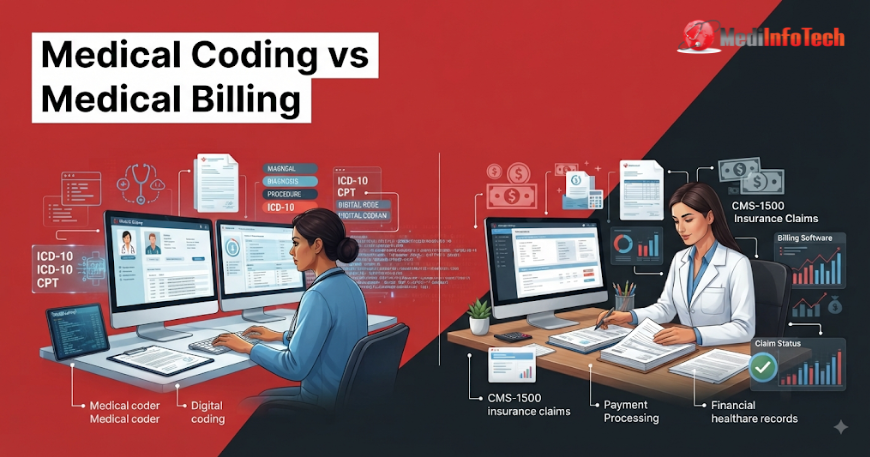
Medical coding and medical billing are two closely connected functions in the healthcare revenue cycle, but they are not the same job. Both play an important role in helping healthcare providers maintain accurate records, submit insurance claims, and receive appropriate reimbursement for the services they provide.
Understanding Medical Coding vs Medical Billing is particularly important for hospitals, clinics, physician practices, and healthcare organizations that want to improve their administrative and financial processes. Our Certified Inpatient Coder CIC Certification. While medical coding focuses on translating clinical information into standardized codes, medical billing focuses on using that information to prepare and manage claims and payments.
What is Medical Coding?
Medical coding is the process of converting information from a patient’s clinical documentation into standardized medical codes. Coders review medical records to identify diagnoses, procedures, treatments, and other reportable healthcare services.
Depending on the healthcare setting and applicable coding system, professional coders may work with diagnosis and procedure code sets such as ICD, CPT, and HCPCS.
For example, when a patient visits a healthcare provider for a particular condition, the medical documentation contains information about the patient’s diagnosis, examination, treatment, and services provided. A medical coder reviews this documentation and assigns the appropriate codes according to established guidelines.
Key Responsibilities of Medical Coders
Medical coders typically handle tasks such as:
- Reviewing patient medical records
- Identifying documented diagnoses
- Assigning appropriate diagnosis codes
- Coding procedures and medical services
- Reviewing physician documentation
- Checking for coding inconsistencies
- Following applicable coding guidelines
- Supporting accurate healthcare data reporting
The primary objective of medical coding is to ensure that clinical information is represented accurately and consistently in coded form.
Healthcare organizations looking for professional support can explore medical coding services to strengthen their coding workflows.
What is Medical Billing?
Medical billing is the process of preparing, submitting, tracking, and managing healthcare claims so providers can receive payment for services delivered to patients.
Medical billers work with the information generated through clinical documentation and coding. They may verify patient and insurance information, prepare claims, submit them to insurance companies or relevant payers, monitor claim status, and address payment-related issues.
Key Responsibilities of Medical Billers
Medical billing may involve:
- Verifying patient information
- Checking insurance eligibility
- Preparing healthcare claims
- Submitting claims to payers
- Tracking claim status
- Posting payments
- Identifying unpaid claims
- Following up on outstanding balances
- Managing claim corrections
- Supporting denial management
The main objective of medical billing is to help healthcare providers manage the financial side of healthcare services and maintain an efficient reimbursement process.
Organizations that need assistance with the financial side of healthcare administration can consider Medical Billing Services from an experienced healthcare support provider.
Medical Coding vs. Medical Billing: What Is the Difference?
The simplest way to understand Medical Coding vs Medical Billing is to look at their primary functions.
Medical coding converts clinical documentation into standardized medical codes, while medical billing uses coded information to create and manage healthcare claims and payments.
Medical Coding | Medical Billing |
Focuses on clinical documentation | Focuses on claims and payments |
Assigns standardized medical codes | Uses codes to prepare claims |
Requires knowledge of medical terminology and coding guidelines | Requires knowledge of billing processes and payer requirements |
Supports accurate representation of diagnoses and procedures | Supports reimbursement and payment collection |
Primarily reviews medical records | Primarily manages financial and insurance information |
Helps create accurate coded data | Helps manage the claim lifecycle |
Despite these differences, coding and billing are interconnected. An error during the coding stage can affect the billing process, while incomplete billing information can cause issues after correctly coded information reaches the claim stage.
How Medical Coding and Billing Work Together
Medical coding and billing can be viewed as different stages of the same broader revenue cycle.
A typical process may look like this:
Patient receives care → Provider documents services → Medical coder reviews documentation → Codes are assigned → Medical biller prepares claim → Claim is submitted → Payer processes claim → Payment or denial is received → Follow-up is performed
Each stage depends on accurate information from the previous stage.
For instance, if a procedure is documented by a healthcare provider but incorrectly coded, the resulting claim may not accurately represent the service provided. Similarly, if coding is accurate but patient insurance information is incorrect, the claim can still experience delays or rejection.
This is why healthcare organizations often focus on both coding quality and billing efficiency rather than treating them as completely separate functions.
Why Accurate Medical Coding Matters
Accurate coding is essential because coded information is used for multiple administrative and financial purposes. Errors can create inconsistencies between clinical documentation and claims.
Reliable medical coding can help healthcare organizations:
- Improve claim accuracy
- Reduce avoidable coding errors
- Support appropriate reimbursement
- Maintain consistent healthcare records
- Improve reporting quality
- Support compliance
- Reduce administrative rework
Medical coders must avoid making assumptions that are not supported by documentation. Their work requires attention to detail and an understanding of coding rules and medical terminology.
Why Efficient Medical Billing Matters
Medical billing is equally important because it helps convert healthcare services into properly managed financial transactions.
A well-organized billing process can help providers monitor claims from submission through payment. It can also help identify unpaid claims, billing errors, and other issues that require follow-up.
Efficient billing may contribute to:
- Faster claim processing
- Better payment tracking
- Reduced administrative workload
- Improved claim follow-up
- Better visibility into outstanding accounts
- More organized revenue cycle operations
For healthcare organizations handling large claim volumes, professional support can make billing workflows more manageable.
Medical Coding and Billing in Revenue Cycle Management
Revenue cycle management covers the financial journey of a healthcare service, from patient registration and insurance verification through claim submission, payment, and account resolution.
Medical coding and medical billing are both important components of this process.
Coding provides the standardized representation of the clinical services documented by healthcare professionals. Billing then uses relevant information to prepare and manage claims.
Other activities, such as eligibility verification, claims processing, payment posting, denial management, and accounts receivable follow-up, also contribute to the overall revenue cycle.
Healthcare organizations can use Healthcare Revenue Cycle Management Services to support different stages of this process and improve administrative coordination.
Conclusion
Looking for reliable medical coding and medical billing services for your healthcare organization?
Contact Medi Info Tech today to discuss your requirements and discover professional healthcare support solutions designed to improve accuracy, efficiency, and revenue cycle performance.
